
Greenhouse gas (GHG) emissions, primarily caused by the burning of fossil fuels, deforestation, and livestock farming, significantly contribute to the greenhouse effect and global warming. These processes have serious consequences for the environment, human health, and well-being, and can lead to catastrophic environmental changes.
The Paris Agreement aims to limit global warming to a maximum of 1.5°C above pre-industrial levels. To achieve this goal, GHG emissions must be halved by 2030 and climate neutrality reached by 2050. As a company deeply committed to sustainable development, Plastika Skaza actively contributes to these objectives.
GHG emissions intensity per revenue measures the amount of emissions per million euros of revenue and serves as a key indicator of a company's environmental efficiency. As revenue grows, the carbon footprint may increase, making it essential to continuously optimize processes and implement measures to reduce emission intensity.
The table below presents data on revenue, Scope 1 and Scope 2 emissions, and GHG emission intensity for the period 2019–2025. In 2022 and 2023, emission intensity increased due to challenges in securing electricity from renewable sources.
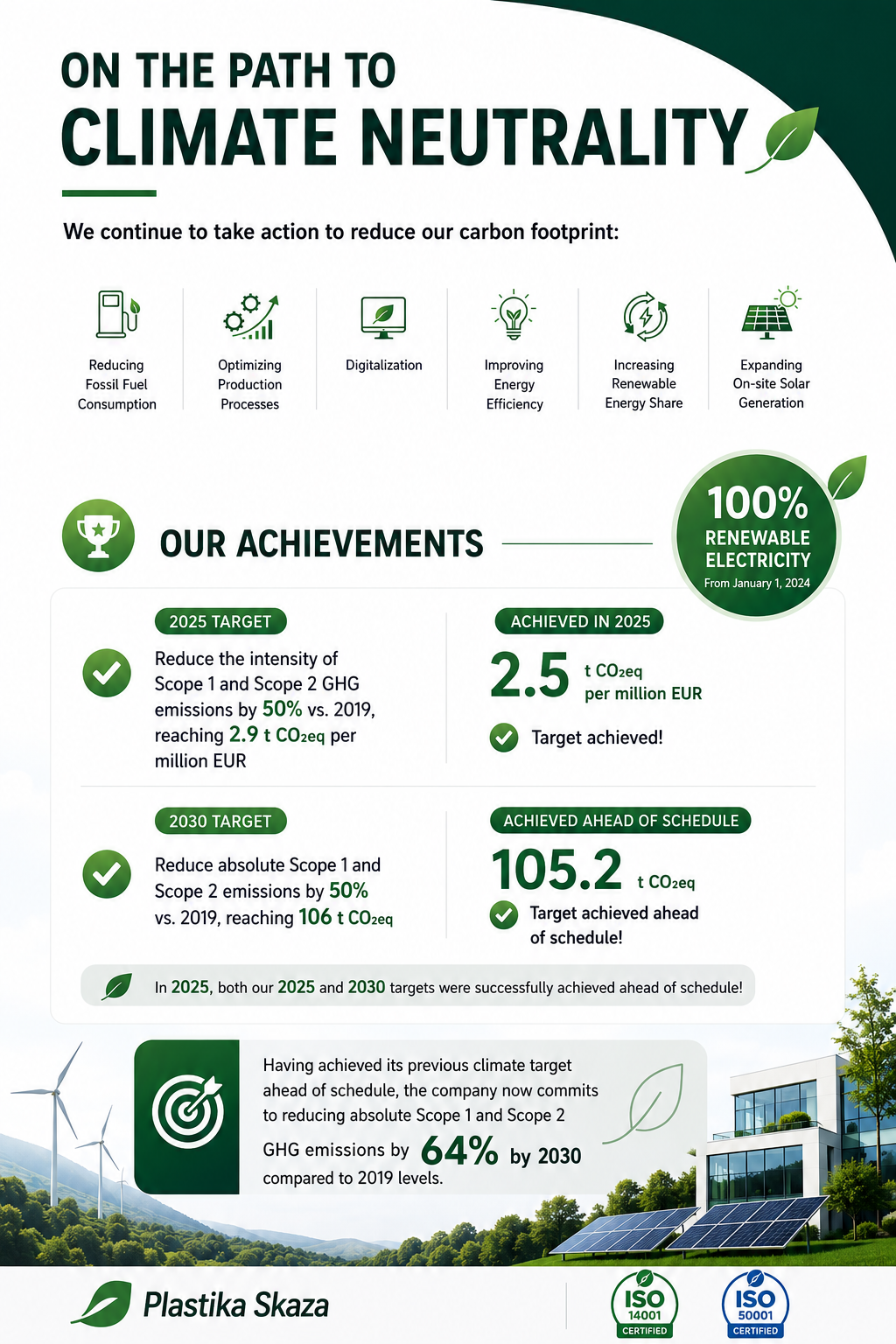
Plastika Skaza has set a target to reduce the intensity of Scope 1 and Scope 2 GHG emissions by 50% by 2025 compared to the 2019 baseline, reaching 2.9 t CO₂eq per million EUR, and to further reduce absolute Scope 1 and Scope 2 emissions by 50% by 2030, corresponding to 106 t CO₂eq. Both targets were successfully achieved ahead of schedule in 2025.
Building on the successful achievement of its previous climate target ahead of schedule, the company is raising its ambition and now commits to reducing absolute Scope 1 and Scope 2 GHG emissions by 64 % by 2030 from a 2019 base year.
|
Year |
Revenue (million EUR) |
Scope 1 and 2 Emissions (t CO2eq) |
GHG Emission Intensity |
|
2019 |
36.2 |
212.0 |
5.9 |
|
2020 |
31.0 |
383.0 |
12.4 |
|
2021 |
38.7 |
220.7 |
5.7 |
|
2022 |
43.2 |
1481.1 |
34.3 |
|
2023 |
38.2 |
858.7 |
22.6 |
|
2024 |
37.8 |
121.4 |
3.2 |
|
2025 |
41.4 |
105.2 |
2.5 |
Carbon intensity based on revenue at Plastika Skaza. In 2025, Scope 1 emissions amounted to 61.2 t CO₂eq, while Scope 2 emissions totaled 43.9 t CO₂eq.
We continue to implement a range of measures to further reduce our carbon footprint on our path to climate neutrality, including reducing fossil fuel consumption, optimizing production processes, advancing digitalization, improving energy efficiency, increasing the share of renewable energy sources, and expanding on-site solar energy generation.